What do we get from philosophy? Can it set a wayward ship right? We’ve seemed to abandon it, like a book we’ve already read.
I think of it as an evergreen pasture. We graze to satiation then, like food, turn away for a time before digging in with renewed vigor once more.
Every year or few I reread The Meditations of Marcus Aurelius, and each time I am both educated and reminded of my past lessons. Stoicism has a warped image in the zeitgeist. We describe people who show no feeling and express no emotion as stoic, but it’s worth taking another look to see what we may have missed.
In the opening book of the emperor’s journal, he describes all of the worthy characteristics of those around him. He lists the traits he admires in others and wishes to, in some manner, emulate. It’s a worthwhile arrangement of blessings and praise, and we all might benefit from attempting it ourselves.
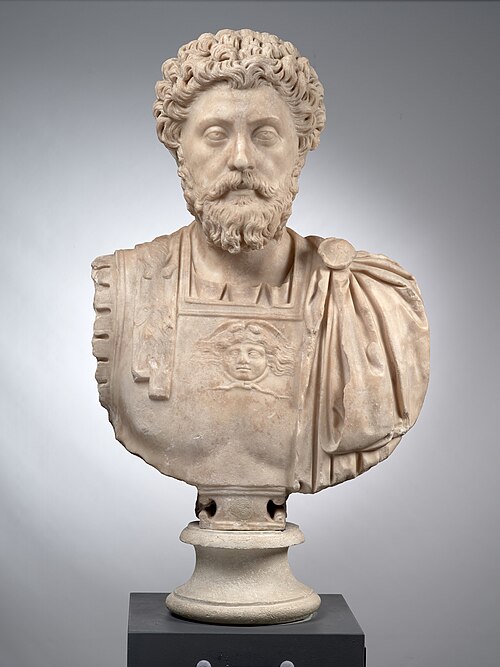
Bust of Marcus Aurelius. By Daniel Martin - Photothèque du musée Saint-Raymond, CC BY-SA 4.0
I have gathered over 80 of these life lessons written in the form of advice so that they may be considered and applied to our own lives. They are listed roughly in the order in which they appear in the chapter. A few might be similar to others, but each offers a different aspect of the message, like a mirror positioned at various angles.
- Cultivate character and self-control.
- Have integrity and manliness.
- Revere the divine.
- Be generous.
- Be not only unable to do wrong, but be unable to even conceive of it.
- Live simply, unlike the rich.
- Avoid public schools and hire good private teachers.
- Don’t support this side or that in sports or with brands.
- Put up with discomfort and do not make demands.
- Do your own work.
- Mind your own business; have no time for slanderers.
- Do not waste time on nonsense.
- Do not be taken in by tricksters or magic.
- Do not be obsessed with crazes or fads.
- Hear unwelcome truths.
- Practice philosophy.
- Do not be sidetracked by your interests.
- Do not write on abstract questions or deliver moralizing sermons.
- Do not compose imaginary descriptions like “The Simple Life.”
- Steer clear of oratory, poetry, and belles lettres.
- Do not dress up just to stroll around the house.
- Write straightforward letters.
- Be conciliatory when others want to make up.
- Read attentively—do not be satisfied with the gist of it.
- Do not fall for smooth talkers.
- Be independent and reliable.
- Be the same in all circumstances.
- Show both strength and flexibility.
- Be patient in teaching.
- Learn to accept favors gracefully.
- Be kind.
- Live as nature requires.
- Show sympathy for friends.
- Show tolerance for amateurs and sloppy thinkers.
- Get along with everyone.
- Do not display anger or other emotions.
- Be free of passion yet full of love.
- Praise without bombast.
- Do not constantly correct people.
- Debate the issue, not the phrasing.
- Recognize the malice, cunning, and hypocrisy power produces and requires.
- Do not pretend to be busy.
- Do not shrug off resentment—try to make things right.
- Show your teachers respect and your children love.
- Love family, truth, and justice.
- Conceive a society of equal rights, status, and speech.
- Be steady and constant when studying philosophy.
- Help others and be eager to share.
- Never doubt your friends’ affection for you.
- Have self-control and resistance to distractions.
- Be optimistic in adversity, especially illness.
- Have a balanced personality, with dignity and grace together.
- Do your job without whining.
- Be neither rash, hesitant, bewildered, nor taken aback.
- Be generous, charitable, and honest.
- Stay on the path rather than be kept on it.
- Have a sense of humor.
- Listen to anyone who can contribute.
- Treat people as they deserve.
- Know when to push and when to back off.
- Do not expect others to keep you entertained.
- Be consistent with friends; never get fed up with them or play favorites.
- Always be self-reliant and cheerful.
- Plan things in advance.
- Restrict all attempts to flatter you.
- Be constantly devoted to the community’s needs.
- Practice no demagoguery, no currying favor, no pandering.
- Be always sober, always steady, never vulgar or prey to fads.
- Make use of material comforts if they are there; do not miss them otherwise.
- Never be glib, shameless, or pedantic.
- Respect people who practice philosophy.
- Feel at ease with others and put them at ease without being pushy.
- Take adequate care of yourself.
- Yield the floor to experts.
- Do not go off on tangents.
- Keep few secrets.
- Focus on what needs doing, not glory or praise.
- Do not bathe at strange hours.
- Do not indulge in buildings, food, clothes, or attractive mates.
- Never be rude, lose control, or turn violent with anybody.
- Approach everything logically and with due consideration.
- Be decisive and have no loose ends.
- Enjoy and abstain from vices with ease.
- Don’t lose your virginity too soon; put it off even.
- Don’t do anything you’ll regret later.
With consent and consideration, I trust that this will prove to be an opening salvo in defense of right character, correct thought, and prudent action, or at least a welcome reinforcement thereof.
If you wish to read the full text of The Meditations, you may do so here.